

The Origin of the Violin
Did the Violin Have Indian Ancestors?
When we think of the violin, we usually picture Italian makers, European orchestras, and Western classical music. But the story of the violin begins long before Italy—and there are good reasons to believe that part of its family tree reaches back into India.
A “bowed veena” in ancient India
Ancient Indian imagination already held the idea of a bowed string instrument. Textual tradition speaks of the dhanur vīṇā—literally “bow‑veena” or “bow‑instrument”—described as a vīṇā played with a bow rather than plucked. Even if scholars still debate the exact details, this term tells us something simple but profound: people here had already conceived of drawing a bow across strings, many centuries before the European violin appeared.
That idea—the marriage of string and bow—is the seed from which an entire family of instruments grows.
A global family, not a single invention
The violin did not suddenly appear in a Cremona workshop out of nowhere. It is the latest member of a long global family of bowed instruments that stretches from India and Central Asia to the Middle East, Byzantium, and medieval Europe.
On this journey, we meet many relatives:
• Indian bowed lutes such as the ravanahatha
• The Arab rebab
• The Byzantine lira
• European instruments like the rebec and the medieval fiddle (vielle)
By the 16th century, Italian makers had refined this long tradition into the four‑string violin we know today. So instead of asking “Who invented the violin?”, a better question is: “Which cultures helped shape the world of bowed strings?” And here, India has a strong claim.
Ravanahatha: a very old Indian cousin
One of the most fascinating Indian instruments connected to this story is the ravanahatha (also called ravanhatta, ravanastra, and other variants). It is still played today in parts of Rajasthan and Gujarat, and is also associated in legend with Sri Lanka.
The ravanahatha typically has:
• A coconut shell or wooden gourd covered with skin as the resonator
• A long neck
• One or two main strings, sometimes with extra sympathetic strings
• A bow drawn across the strings
Folk traditions link it to the story of Ravana and to very ancient times. Historians are cautious about exact dates, but many agree that instruments like the ravanahatha belong to some of the earliest generations of bowed lutes anywhere in the world. Structurally and conceptually, it sits in the same broad family as the instruments that eventually led to the violin.
We cannot prove a straight line from Ravanahatha to the Italian violin, but we can confidently say: if you follow the “bowed string” trail backward, you very quickly find yourself in India.
From East to West: how the family evolves
If we zoom out, the story looks something like this:
• In South Asia, people imagine and play bowed instruments like the dhanur vīṇā and ravanahatha.
• In the Islamic world, we find the rebab, a small bowed lute that appears in historical records by about the 10th century.
• In the Byzantine Empire, a related instrument, the lira, becomes popular.
• In medieval Europe, these ideas gave rise to the rebec and the vielle (medieval fiddle).
• Finally, in 16th‑century northern Italy, makers refined this family into the violin, standardising its shape, tuning, and construction.
This is not a simple, one‑way road; ideas and designs move in many directions. But when you look at the full map, India is clearly on it—not on the edges, but at the very old, eastern end of the bowed‑string story.
Stone violins: what temple sculptures show us
Words are one kind of evidence; stone is another. South Indian temples, especially from the Chola period, preserve beautiful sculptures of musicians that add a visual dimension to this history.
One powerful image comes from the Agastyeshwara (Thirumukoodal) temple near Mysuru. On one of its pillars, a woman sits cross‑legged with her right foot extended. Resting on that foot is a slender, lute‑like instrument, and in her hand is a bow. The way she holds and plays the instrument looks astonishingly like the posture of a modern Indian violinist.
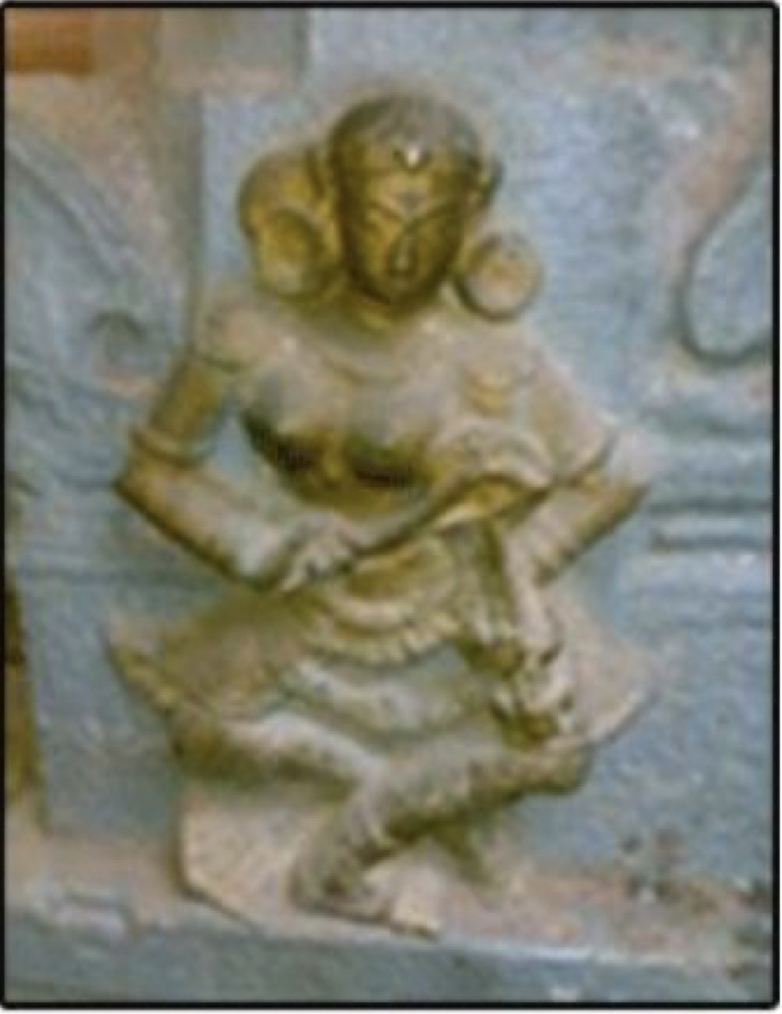
Thirumukoodal (Mysuru) sculpture “Female musician playing a bowed lute, Agastyeshwara (Thirumukoodal) temple near Mysuru, c. 8th–10th century CE, Chola period. The posture—seated, with the instrument’s end resting on the right foot and a bow drawn across the string—closely resembles the way South Indian violinists sit and play today.”
Scholars may call this instrument a dhanur vīṇā or simply a bowed lute rather than a “violin” in the strict sense. But for a musician’s eye, the continuity is striking: a treble melodic instrument, supported by the body and foot, sung through a bow.
At Chidambaram, another great Chola temple, we see similar sculptures of musicians with narrow, bowed lutes. Once again, these carvings are from many centuries before the European violin reached India, yet they show that South India already had a sophisticated bowed‑string culture.
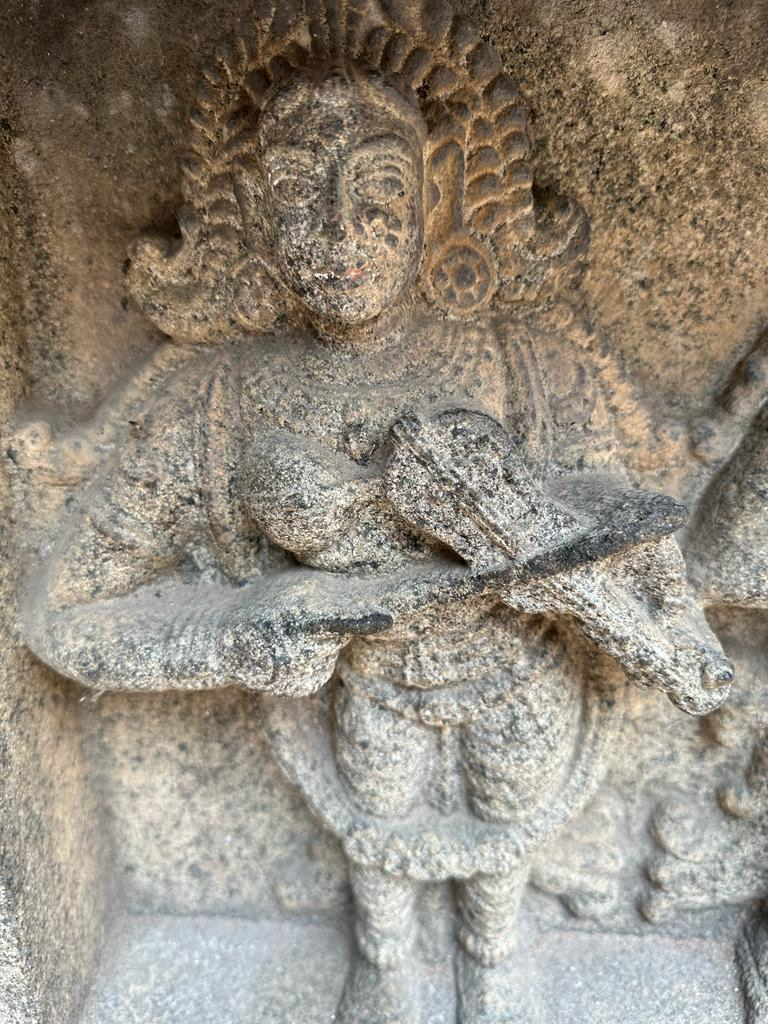
“Temple sculpture from Chidambaram, Tamil Nadu, showing a musician with a slender bowed lute. The elongated body, string, and bow suggest a refined bowed‑string tradition in South India centuries before the European violin arrived.”
Even at Ramanathaswamy temple in Rameswaram, a site linked by tradition to Lord Rama, later medieval and early‑modern panels depict musicians playing violin‑like instruments. The temple we see today is historically much younger than the Ramayana, but the sculptures visually connect a sacred landscape to the evolving practice of bowed strings.
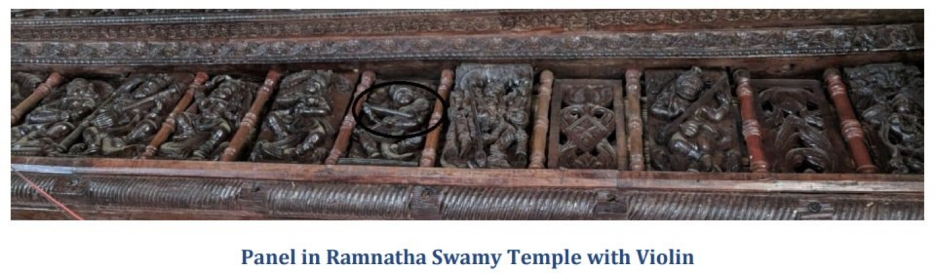
Ramanathaswamy (Rameswaram) Panel from the Ramanathaswamy temple at Rameswaram, a medieval–early modern complex linked by tradition to the Ramayana. A musician plays a violin‑like instrument, visually tying the sacred landscape to the evolving history of bowed strings in India.”
Legend, history—and a fair conclusion
It’s important to be honest about two different kinds of time in this story:
• Sacred time, where instruments are linked to figures like Rama or Ravana, and temples are said to belong to the age of the epics.
• Historical time, where archaeologists and epigraphists date actual stone temples and instruments to specific centuries.
For a thoughtful reader, both layers can coexist. We can cherish the legends and devotional meanings, while also respecting what history and archaeology can actually prove.
So what can we fairly say?
• The modern violin is a European instrument perfected in 16th‑century Italy.
• But the idea of bowed strings—and several early members of the bowed‑string family—arose much earlier in Asia, including India.
• Indian concepts like the dhanur vīṇā, instruments like the ravanahatha, and temple sculptures of violin‑like lutes show that India was not just a later adopter, but an early and creative home for bowed‑string music.
In that sense, it is entirely reasonable to say:
The violin may have ancestors in India.
Not as a simple slogan that erases other cultures, but as a nuanced recognition that the violin’s family tree has many roots—and India is one of the oldest.
