

Influence, feeling and the art of playing with Indian violinist Kala Ramnath
By Tim Wassberg, Bennington Banner
Apr 3, 2025
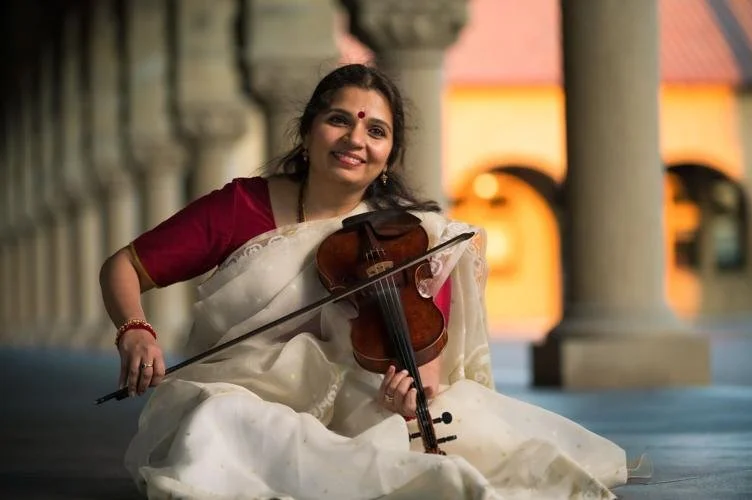
Classical Indian violinist Kala Ramnath.
Classical Indian violinist Kala Ramnath performing "Concerto for Hindustani Violin and Orchestra." at its world premiere with the Seattle Symphony. Ramnath will be performing the piece with the Albany Symphony at the Palace Theatre in Albany on April 5.
Classical Indian violinist Kala Ramnath performing "Concerto for Hindustani Violin and Orchestra." at its world premiere with the Seattle Symphony. Ramnath will be performing the piece with the Albany Symphony at the Palace Theatre in Albany on April 5.
Musician Kala Ramnath has been playing music all her life. As an Indian classical violinist, her approach and instinct is very different from that of the West even though she lives in California. She is bringing a composition she collaborated on with composer Reena Esmail called “Concerto For Hindustani Violin and Orchestra” and playing it with the Albany Symphony Orchestra on April 5 at the Palace Theater. Ramnath talked to the Banner by Zoom from India a week before she traveled back to the U.S. to discuss approach, influence, feeling and the art of her playing. That day she was set to travel to a performance venue in the Himalayas to give a performance.
Starting off the conversation, Ramnath says environment is very important to her, “in the sense that when I'm playing right, it inspires me.” She says "environment" could mean people. It could mean nature. “Because the music I play is connected with nature in a great way.” She explains that her style of music as the oldest form of music in the world (“ragas”). “So it has a connection with nature. All these ragas that I play, it is all based on micro-tones.” She explains that these ragas have a connection with the physiology of a human being. “So 'raga' literally means something that colors your mind. So when I play a particular scale, which is basically a raga, all of it is improvised.” She says perhaps a minute and a half of each performance is what the actual composition is. “Apart from that, everything is improvised. So for me to do that, I have to literally — and spiritually — invoke that scale and request it to give me a vision of itself.” She adds that every time she's improvising, “I don't know what's going to come out...and I don't know how it is going to influence the listener.” She understands that her playing could or could not have an impact. “That is not in my hands. It is about in the environment that I'm in.” When the audience is in front of her, she explains, if depends how receptive they are. Everything influences the space. “But the reason [the approach] does not change for me is that for me (internally) music is spiritual. It's my way of life. When I'm on the stage, I'm not myself. I always think, 'Was that me? Was that what I created?'" She explains that because this type of playing is primarily improvised, it is based around the concept that these ragas have a specific approach. “It's not like Western classical music, where I'm playing with the counts. This is a scale and you've given certain colors. And if you're asked to make a painting, you cannot use any other color. That is the structure I'm in.”
Ramnath specifies this more intrinsically: “If there is the [musical] scale in front of me, and I'm told I cannot use any other notes within this scale, then within these notes, you can improvise. But that means you cannot use any other note other than what is given to you [in the scale].” She adds that, for her, there is a direct reason for it within this composition that she will be performing with the Albany Symphony (which in turn world premiered with the Seattle Symphony).
“I was [supposed to be] in California in 2020 during the pandemic. But I was stuck in India. I was set to tour that March, and then slowly, all my concerts got canceled.” She was in India for work, and getting set to fly back to the US...”and all my flights got canceled. So for three months, I was stuck here in this apartment with nowhere to go and no one to talk to. I was alone.” She explains that her whole family is in the US...”and I was stuck here [though] I live in California.” She says eventually the US government brought flights to take citizens back to the US. “So I took one of those flights — and that was on on June 10, 2020 — but from March to June, I was stuck here.” She says all she experienced during that time was from her window. "But I could see that the air was cleaner because no cars were moving...nothing. I could see peacocks coming out onto the roads. Everything was so beautiful. Even up north, you could see the mountains...the Himalayas which are like 600 miles away. That was how clear the air was.” She says then she went to California, “and there were these forest fires happening. I have pictures of ones near my house. The sky was orange. Everything was orange.” She says because she had no concerts and nothing to do, she started researching. “And I was thinking, in Indian music, we have scales, or ragas for the rains, for seasons. And we have ragas for therapy like blood pressure, insomnia, everything. So I said, 'Can't there be something for all these elements [right now] which are imbalanced?'” In her research, she came to find that 5000 years ago in Indian culture, there had been scales for the elements. “And when I play, I do play all those scales." And then a thought came to her: "The Earth is made up of all the five elements. We are made up of the five elements. If we have a two-degree rise in temperature in our body, we have fever. If our air element is imbalanced, we have flatulence. If our water element is imbalanced, our kidneys are giving us problems. Everything we know know is within us. And yet after having experienced all this, we [still] do this to the Earth. A two digit rise in temperature to the earth means disaster.”
There is an inherent irony and thematic within these ideas which became a musical journey. “And I alone cannot show the good and the bad through music of what we are doing to the Earth. But – if all the elements are in balance – then life is going to be good. If they are imbalanced – and I didn't want to preach – but I wanted to show that through music.” She says when she hears the notes within the specific musical scale of the raga, “and you keep mulling over it, you are trying to develop that scale, you realize how perfect this kind of approach is for that.”
When asked about congruence to musical intonation, Ramnath responds: “Do you know with Western violin earlier, in maybe the 11th or 12th Century, it had more a common with Indian classical music.” She recounts having played with a Baroque orchestra, “and I found so many similarities between what Indian music is today and what Western classical music was...and I wanted to show that through this music.” Ramnath says in working on this composition she knew she couldn't show the gamut of that influence with just her one instrument. “I need an orchestra which brings in that...that magnitude of how we are progressing towards disaster.'” The concerto, she explains, was premiered with the Seattle Symphony. It was also played at the National Arts Centre in Canada as well as with the Long Beach Symphony in California. She adds that composer Reena Esmail was there to help her put everything together in terms of the piece itself, “So she takes a big chunk of the credit for having written this in such a way that it worked for me and for the orchestra. But when I was writing this music, I also found that in in Hindu scriptures written 10,000 years ago, there are verses sung in praise of Mother Earth,” She explains that the verses approximately say “'Mother...you have given us the mountains. You have given us the pure flowing rivers, good water, good air.” She adds the verses make reference to medicinal, herbs, food, animals and their importance. “And this was 10,000 years ago they had written this: 'We are soiling you [Mother Earth] and we seek your forgiveness.' So I take those verses towards the end after the composition ends...and I sing them...and they are in Sanskrit.” Ramnath adds that the the impact it has on the audiences every time she played is amazing, “They do feel it. They feel it. They feel that if all of us did something in our own little way — if all of us joined together — it would work.”
As far as her connection to music, Ramnath says she was two years old when her grandfather started her out on the violin. “And I don't know how I was, so I asked my mom: 'How was I when I was two years old?' And she said, 'Your grandfather started you on the full size violin, and you complained....'What is this? Get me a smaller one.'” She adds that her mom also told her that her grandfather would patiently say, 'I'll help you. I'll help you hold this. I'll help you do this.'” Her mom continued: “The way he started you out, it was just three four minutes a day, just to get you started. And in two years you were playing, You could sit for half an hour, 45 minutes.” Ramnath says by the time she was seven, “I was practicing four, five hours a day, and I was a prodigy. Everybody was coming to know that, 'Oh, my God, this little kid is good.'” She continues that that the best thing her grandfather did was not force her to play. “The love for music was inside me. And when I was seven years old, I felt that, that the music was so beautiful, that this is what I what I want to do all my life.” Ramnath adds that this is what her grandfather inculcated in her, “not the fear, not this thing that, 'Oh, I have to practice every day. You have to do this.' I did it, but the way he made me learn it was like having breakfast or having a shower, things I do every day.” She says it just became part of life. “And when I look back, the reason why I want to spread and teach and talk about what I do is because of what my grandfather taught me. He taught me my love for music. He didn't tell me to practice seven, eight hours. I did it on my own.” However, she says, he made it so much part of her day “that I would feel guilty if I went to watch a film with my friends and then come back, because I would think, 'Oh my God, four, five hours gone. I've wasted it. I need practice.'” Ramnath says that worked in her childhood and even up until she was 28 or 30 years old. “But now I have command on these scales that I play today. I don't need to sit and practice. I can go right on stage.”
She uses the concert she is doing in the Himalayas the next day as an example. “I am going there one day early to acclimatize. I think the performance space is at 5000 feet. But my plan is to go there today, and then I have the whole of tomorrow. And I will feel the energy there.” She says an environment like that is very different from being in a city. “I want to get the feel of it completely. And I don't know if I will have a tabla player but if there is one, [he can] come onstage and we still can play well. That's the kind of familiarity I have with my music.” Ramnath however says she cannot take all the credit for what she does. “There is some energy, which makes it happen.”
Ramnath says before the pandemic happened, “I could call myself a different person.” She admits she was in the rat race. “I wanted to perform. I wanted to play here. I wanted to play there...just like every other artist would do." However during the pandemic, she saw so many legends (musical and otherwise) pass away. “And they were literally alone when they passed and yet they had a personality which was larger than life. Everything was nothing in a few seconds.” Ramnath admits that completely changed her perspective. “I realized I didn't want to be in that rat race anymore. I play music because I love music. And awards? Who doesn't feel happy if you get awards? But I'm not looking for that. That is not my goal.” For her now, when she plays, “I enjoy myself when I play. And then I will dedicate the concert if it goes well." She chuckles: "Literally, before I go on stage, I have this little prayer. And I will pray. And then I say (looking up), 'Look, if the concert goes well, it's all yours. But if it doesn't go well, that's also yours.' (laughing) So I remember.”
A major change in her life happened just three months ago when her mentor, tabla legend Zakir Hussain passed away. “And that was a real, real shock for me, because he was so much to me in my life. After losing him literally, for one month, I didn't perform. I canceled all my concerts, and I was just at home, so depressed. He was such a great musician. Every time I heard him, I would feel inspired and depressed at the same time.” She was inspired simply by how he played. “I wanted to practice, to do some of the pieces he did but then [I had the] realization that he'd done it, so there's no way any musician can get there.” Ramnath does say beyond that, Hassain's personality, his presence, “the human being that he was...it was too much. I've never seen somebody so humble, so kind, so helpful.”
She gives a very specific example where his guidance helped her. “I have to tell you, just after the pandemic in 2021, I went through a big bout of depression. And I was touring with [Zakir] in 2022.” She says when they were touring, she was having problems with her bowing, “and I didn't know what was happening. I was literally going crazy.” Whereas before she would play, now she would be writing everything she imagine because she thought she wouldn't be able to play it in concert. “There were papers streamed all around in my room. I could not sleep at night because it was like 'What's going on with my bow?' I just couldn't do it. I had no control over it.”
She says Hassain saw her struggling. He called Edgar Meyer (a bassist and composer) without her knowledge and told the bassist: “Kala is struggling with this. What's her problem? Why is this happening?'" Hassain had told her Edgar said, “She's putting a lot of pressure on the bow. Ask her to reduce the pressure. There's something going inside her. She's putting [too much] pressure on the bow.”
Ramnath says Hassain called her to his room in the hotel they were staying. “He said, 'Get your violin and come up.'" And then he said, "'Now play that [scale.' And when I played, he said, 'Reduce the pressure, reduce the pressure, reduce the pressure.' And at one point it became alright.”
He then told her to go to her room in the hotel and continue practicing but to send him videos of her progress. “Now tell me in today's age, which musician would do this for another musician? Nobody. I was literally in tears at what he did for me. When I was down, he would keep me up.” She continues that on tour, Hassain would tell her fellow musician: Indian instrumentalist: Jayanti Kumaresh, an Indian Veena player she often tours with: “You're not letting her be alone. You're going to check on her till she sleeps. And then you will sleep. In fact, you can stay with her in the same room, but just don't leave her alone.'” She explains that Hassain came into her life the day her dad passed away when she was 12 years old. “and now Zakir died the same day of the year my dad died last year.”
In terms of the cosmic progression of the universe: “I don't have any answer to this, but I just know Hassain wherever he is, he's probably protecting me, which he did all these years. He helped me.”
Hassain would call her, talk to her about her music and give her tips. “He was a person who anticipated what was going to happen. He was too good at that.” She says back in 2008, Hassain heard one of her recordings, and wanted to write the foreword for the liner notes. “And then he says to me, 'You know I always found it difficult to anticipate what you were doing, but now it's becoming easier. So you better change [your approach]. I don't know what you have to do, but you have to change this something in your music.” He always wanted her to keep him *and others guessing.”
Ramnath says their last concert together was at the Sydney Opera House last August. “At an earlier concert in Melbourne, myself and Jayanti [the Veena player]...we had decided [for the performance], 'Oh, we're going to do this. You do this, and I do this.'” She says they we went on stage, Kumaresh was set to play a raga on the downbeat, “something fast and calm, and I would immediately start and come on the downbeat again with another scale. We were going to do that to each other, like four, five times back and forth, trading ends.” She adds that they decided before on the scales that we were going to play, “and suddenly I went blank on stage.” Ramnath says her recovery was that she played something else, which was also good. “But my fear was, 'Am I going back to that state when I was sick three years before.'” Ramnath said she came back to the hotel after the performance, and was very upset with herself. “I had all these thoughts. And Zakir knew that this was affecting me. So he calls me, and he makes me come up and sit next to him.” She describes that there was a sports match happening on TV where a player went to catch a ball...and he was going to go over the boundary, which means it would be ruled not a fair catch. “And what he does is he catches the ball and when [he realizes] going to trip over over the boundary, he throws the ball up, goes over the boundary, then comes back in bounds and takes the catch.” She says Hassain asked her, “'Why is that?' And I said, 'I don't know. He just jumped out and jumped in to get the catch.” He said, 'That's called recovery.” Hassain told her the player had the presence of mind to throw the ball up, jump out and then jump in to take the catch. “He said, 'You may forget a lot of things, but what is important is your recovery. And you recovered very well.'”
Ramnath says she's okay now “but I have to accept [that he is gone]. When my dad passed away, that night [he passed], I felt, 'How will I live? My mother, me, my brother...we how are we going to live without him?' I was 12 years old, and I couldn't sleep the night after my dad died. But the next day, I got up and I was sitting in in the patio watching the sunrise from my house. And I realized, 'Oh, it's another day already. My dad is gone and we are still alive.' So life goes on, and that's it. I'll never see him anymore. It's all over, but we have to live. I am alive.”
She continues that when Hassain passed a few months ago, “that broke me, and I really cried that day more than the seeing my father go. This was more painful because the reality seeped into this life.” She says now “it becomes all the emotions that I put into my music, because I have no other outlet except my music. But I always thank the Lord saying 'Whatever you've given me, you've made me feel I'm special.'”
Kala Ramnath will be performing her “Concerto for Hindustani Violin and Orchestra” on April 5 at the Palace Theatre in Albany with the Albany Symphony Orchestra at 7:30 p.m. Tickets are available at https://www.albanysymphony.com/upcomingconcerts/2025/4/5/reena-esmail-bolro.
